
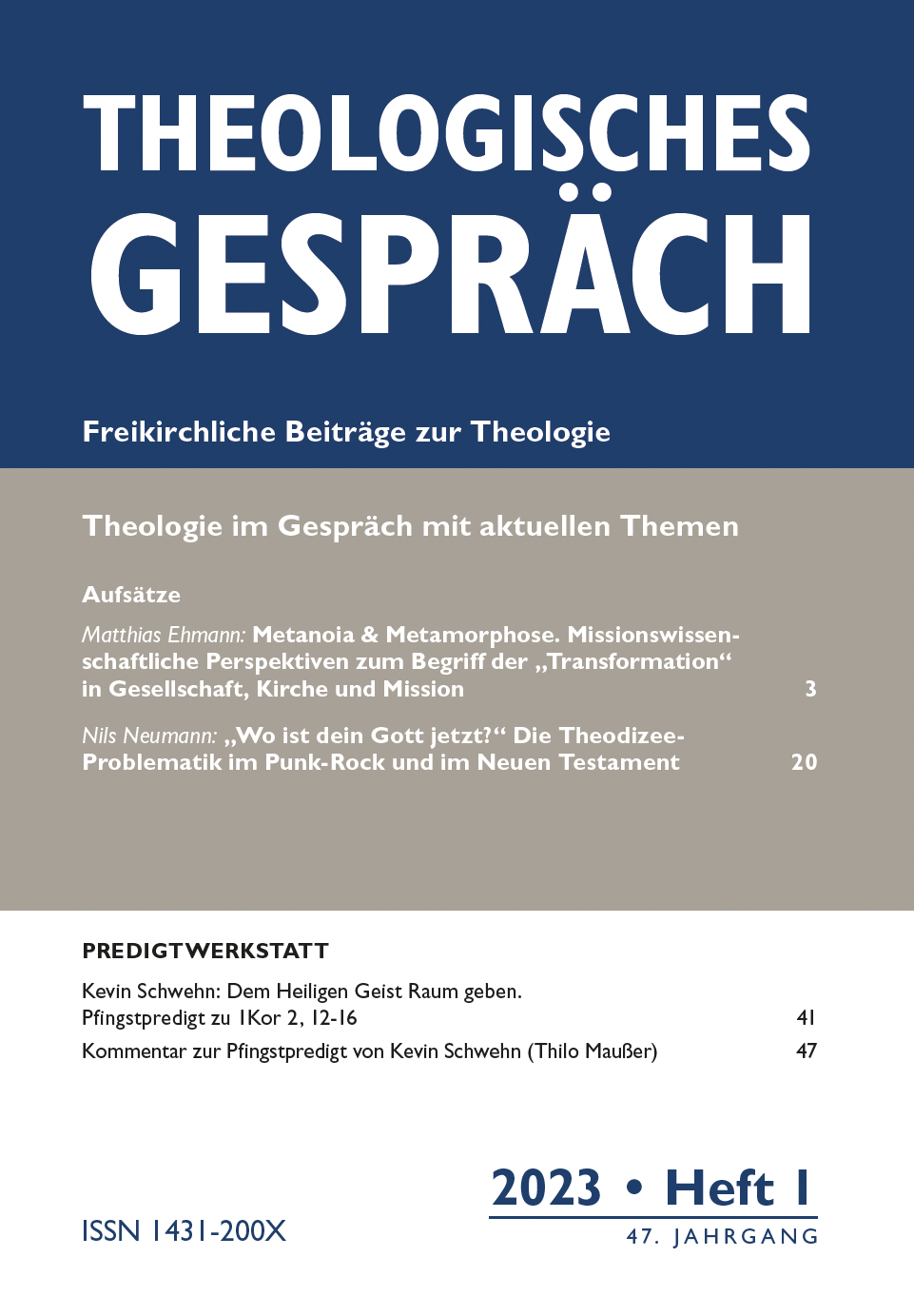
 Aufsätze
- Matthias Ehmann: Metanoia & Metamorphose. Missionswissenschaftliche Perspektiven zum Begriff der "Transformation" in Gesellschaft, Kirche und Mission → English Summary
- Nils Neumann: "Wo ist dein Gott jetzt?" Die Theodizee-Problematik im Punk-Rock und im Neuen Testament → English Summary
Predigtwerkstatt
- Kevin Schwehn: Dem Heiligen Geist Raum geben. Pfingstpredigt zu 1Kor 2, 12-16
- Kommentar zur Predigt von Kevin Schwehn (Thilo Maußer)
Zum Inhalt
Theologie wird dann besonders spannend, wenn sie sich in Beziehung setzt zu aktuellen Fragestellungen. Das hat christliche Theologie seit vielen Jahrhunderten eingeübt. In diesem Heft wenden wir uns zuerst der alten und doch jederzeit neu gestellten Frage der Theodizee zu.
Im Aufsatz „Wo ist dein Gott jetzt?“ Die Theodizee-Problematik im Punk-Rock und im Neuen Testament von Prof. Dr. Nils Neumann, Professor für Biblische Theologie am Institut für Theologie an der Philosophischen Fakultät der Gottfried Wilhelm Leibniz-Universität Hannover, bringt der Autor Aussagen zur Theodizeefrage im Punk-Rock sowie im Neuen Testament ins Gespräch, stellt überraschende Übereinstimmungen und auch Divergenzen fest. Prof. Dr. (Unisa) Matthias Ehmann, Professor für Missionswissenschaft und Interkulturelle Theologie an der Theologischen Hochschule Ewersbach, bringt in seinem Aufsatz Metanoia & Metamorphose. Missionswissenschaftliche Perspektiven zum Begriff der „Transformation“ in Gesellschaft, Kirche und Mission das moderne missionswissenschaftliche Paradigma der „Transformation“ in Beziehung zum Transformationsverständnis in anderen Wissenschaften und zieht daraus Folgerungen für das innerchristliche Gespräch über das rechte Verständnis von Mission. Eine Pfingstpredigt mit dem Thema Dem Heiligen Geist Raum geben von Pastor Kevin Schwehn, Freie evangelische Gemeinde Hamburg-Sasel, bildet die Grundlage zur Predigtwerkstatt. Pastor Thilo Maußer, Evangelisch-Freikirchliche Gemeinde Brandenburg, kommentiert die Predigt.
Mit diesem Heft verabschiede ich mich als Schriftleiter, da ich mich beruflich verändere. Ich bin dankbar für die sieben Jahre als Schriftleiter, blicke stolz auf 28 Hefte Theologisches Gespräch zurück und wünsche meinem Nachfolger in der Schriftleitung: Prof. Dr. Maximilian Zimmermann, Professor für Systematische Theologie an der Theologischen Hochschule Elstal, alles Gute und Gottes Segen.
Michael Kißkalt (Schriftleitung)
Summaries
Matthias Ehmann: Metanoia & Metamorphose. Missionswissenschaftliche Perspektiven zum Begriff der "Transformation" in Gesellschaft, Kirche und Mission: The concept of transformation is widely used in current political-societal conversations. Churches and Free Churches are both actors as well as places of ethical reflection in these conversations. The concept of transformation is also significant in the field of theology of mission, in particular with respect to a holistic interleaving of the formerly polar understanding of the areas of evangelism and social action, as in the Lausanne Movement. Contemporary critiques of the concepts of transformation employ ideas from the doctrine of the two kingdoms. The author advocates a more differentiated approach, which helps missiology to distinguish between descriptive-analytical and normative-visionary perspectives and can be fruitful in dialogue with other scientific disciplines. It is necessary to confront undifferentiated polarising views.
Nils Neumann: "Wo ist dein Gott jetzt?" Die Theodizee-Problematik im Punk-Rock und im Neuen Testament: The theodicy was introduced as term by the philosopher Leibniz, the theme has been present in all times: How to bring together the almighty and loving God and the experience of suffering and injustice. Thus, this theme is found in the lyrics of some punk-rock bands. The author demonstrates in three songs by the Sex Pistols, Terrorgruppe and NOFX that, given the fact of suffering in everyday life and in extreme situations, it is impossible to think of God as existing and a loving God. These songs are compared with the idea presented in the New Testament, where Jesus rejects the question “why”, implied by a scheme of deeds and consequences, and directs the attention instead to the question “what for”, and gives as answer the call to repentance and to glorify God. Both texts challenge people to think about their faith to God.